CRJ Series Operations: Master the Bombardier Regional Jet in MSFS 2024
By the PilotLeague Team — Aircraft Knowledge Module #5
The Bombardier CRJ family is one of the most recognizable regional jets in the sky — over 1,900 built, flown by virtually every major airline's regional partner. From the 50-seat CRJ-200 grinding short hops to the 100-seat CRJ-1000 doing 1,800 NM transcontinental legs, the CRJ taught two generations of pilots how to fly a real swept-wing jet without the autothrottle hand-holding of an Airbus or 737. In MSFS 2024, the Aerosoft CRJ remains the gold standard — but to score well on PilotLeague, you need to understand which variant you're flying, how to manage its quirky T-tail, and where the real fuel-efficiency wins lie. Pilots fresh from the Boeing 737 often blow approaches in the CRJ because the energy management is on you, not the autothrust.
This guide covers all four production variants (CRJ-200, 700, 900, 1000), the GE CF34 engines that power them, the typical regional ops profile, and the specific PilotLeague metrics that the CRJ rewards: stabilized approach, fuel-per-NM, and landing rate. Whether you fly the freeware CRJ or Aerosoft's study-level rendition, the procedures and numbers are identical.
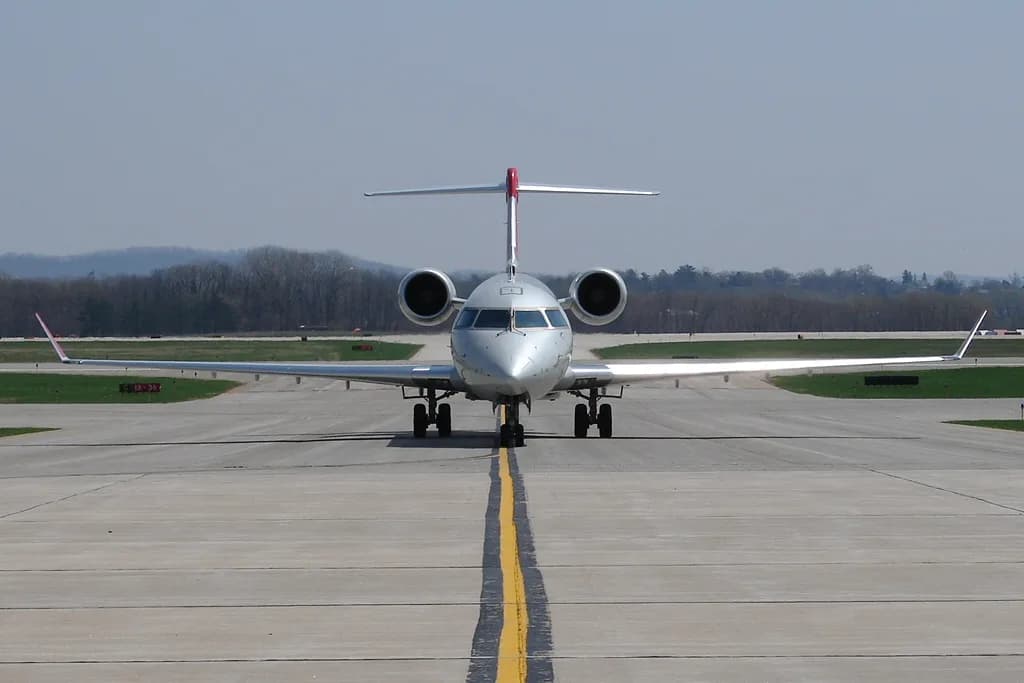
Bombardier CRJ-900 in service — Photo: Cory W. Watts, CC BY-SA 2.0 (Wikimedia Commons)
Four production variants share the same fuselage cross-section and CF34 engine family but differ dramatically in seating, range, and runway needs. Picking the right variant for your virtual route is the first scoring decision.
Variant
Seats
Range (NM)
Engines
CRJ-200
50
1,650 NM
2× GE CF34-3B1 (8,729 lbf each)
CRJ-700
70
1,378 NM
2× GE CF34-8C1 (13,790 lbf each)
CRJ-900
76–90
1,550 NM
2× GE CF34-8C5 (13,360 lbf each)
CRJ-1000
100–104
1,622 NM
2× GE CF34-8C5 (13,360 lbf each)
Performance Specs You Actually Need
Numbers that matter for PilotLeague scoring. These apply to a typical CRJ-900 at mid-weight (35,000 kg) and ISA conditions.
Cruise speed: Mach 0.74 (≈ 425 KTAS) at FL330. Long-range cruise drops to Mach 0.70 (≈ 405 KTAS) for 7% better fuel economy.
Service ceiling: FL410 — but realistic top is FL370 once you account for hot ISA days and full passenger load. The CF34 loses thrust quickly above FL370.
Runway requirement: 1,940 m (6,360 ft) at MTOW. Comfortable on most regional fields. Below 1,500 m you need a payload reduction or a longer takeoff roll than the chart suggests.
Typical fuel burn: 2,200 kg/h at FL370 long-range cruise. Bumps to 2,600 kg/h at FL310 — pay the climb cost, save it back over the cruise.
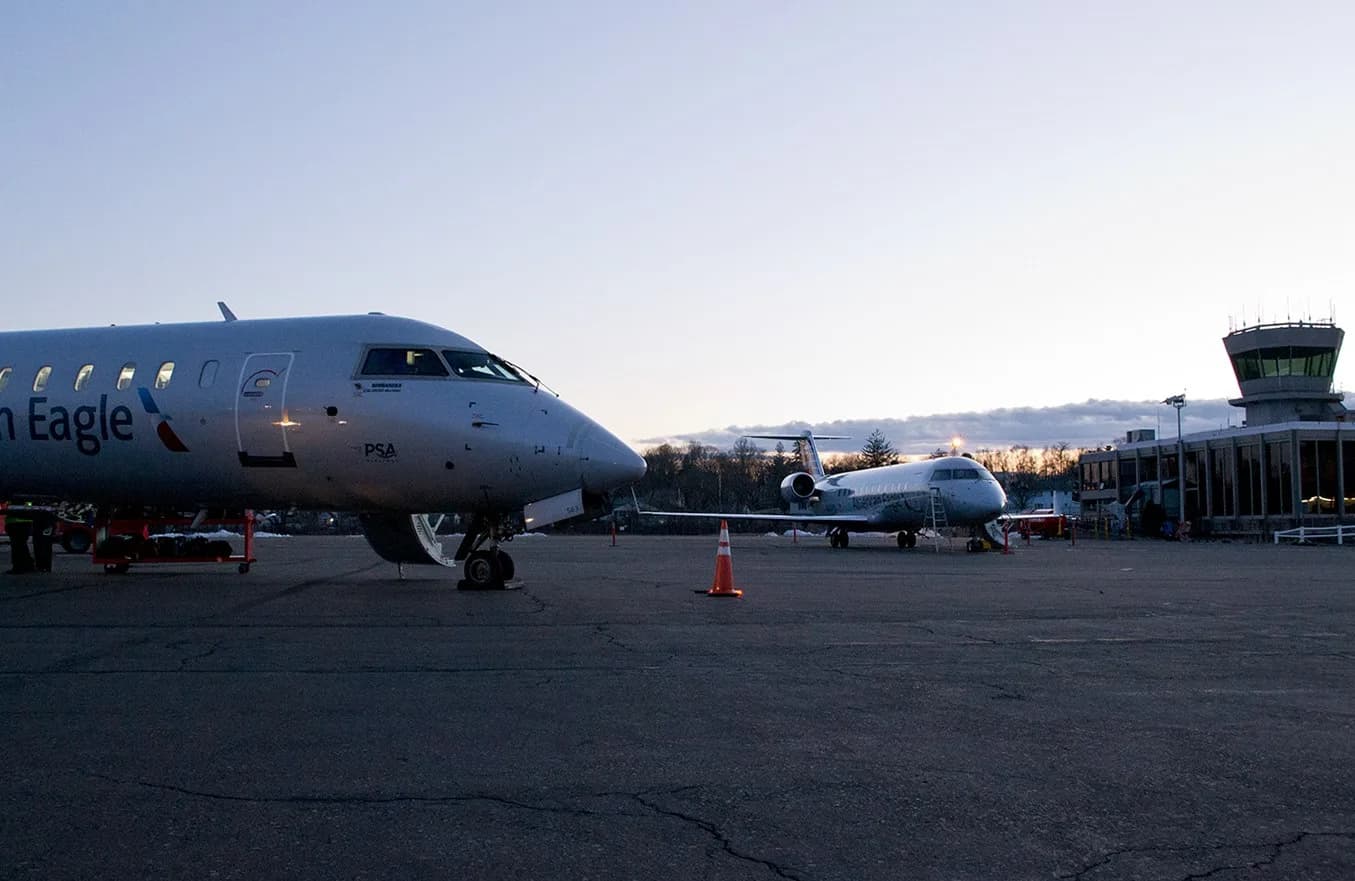
CRJ-900 and CRJ-200 sharing ramp space, Tweed New Haven — Photo: Tweed Mythbusters, CC BY-SA 4.0 (Wikimedia Commons)
Regional Operations: Where the CRJ Earns Its Keep
The CRJ is built for one job: high-frequency, medium-range hops feeding mainline hubs. Think 350 NM legs, 6 to 8 sectors per day, mostly to airports the mainline jets can't economically serve. Block times of 50–90 minutes are the sweet spot — long enough to climb and benefit from cruise economy, short enough to fit into tight airline crew rotations.
Where the CRJ falls down is on legs over 1,200 NM at high payload. The wing is small and clean, but the CF34 is thirstier than a modern E-Jet or A220 at higher cruise altitudes. Plan FL330–FL350 for medium-distance routes, FL370 only for the longest legs with light loads. For the deeper economics, see our cost index guide.
Handling Quirks: What Catches Real Pilots Out
The CRJ flies like a heavy glider — clean wing, no leading-edge devices, and a T-tail that bites in deep stall if you ever get there. The FBW autopilot is excellent, but hand-flying the CRJ in MSFS 2024 surfaces every weakness in your scan.
Takeoff rotation: Rotate at 2.5°/sec to 8° pitch. Pull harder and the tail strike margin shrinks fast — only 10 cm at MTOW. Smooth and slow wins points on PilotLeague's safety score.
Icing sensitivity: The CRJ-200 wing is famously icing-sensitive. Use anti-ice early on the ground (Type IV holdover times) and in flight when in visible moisture below 10°C. Anti-ice on costs you 4% thrust — plan for it.
Landing flare: The CRJ likes a long, gentle flare starting at 30 ft AGL. Flare too aggressively and you balloon; not enough and you arrive firm. See our flare timing mastery guide for the technique that scores 100%.
Fuel Planning the CRJ Way
The CRJ has 9,500–11,000 kg of fuel capacity depending on variant. For most regional ops, you tanker partial fuel — full tanks plus a typical payload exceeds MTOW. Use our fuel planner to compute trip + reserves + alternate.
Standard reserve: 200 kg + alternate (typically 1,200 kg for 50 NM diversion) + 30 minutes holding (≈ 1,100 kg). Add 3% contingency. For a typical 600 NM leg you'll burn around 2,200 kg block fuel — total uplift around 4,500 kg.
Track Your CRJ Performance with PilotLeague
PilotLeague captures 52+ flight variables in real time. For the CRJ specifically, three metrics tell you whether you're flying it like a regional pilot or like someone who just learned the throttle:
Stabilized approach score: PilotLeague checks gear, flaps, configuration and speed at 1,000 ft AGL. The CRJ's narrow speed envelope makes this category-defining — see our landing rate guide for the breakdown.
Fuel efficiency ranking: Your normalized kg-per-NM is benchmarked against other CRJ pilots. Visit the fuel ranking to see your position on identical legs.
Safety score (icing, overspeed, V-speeds): Every overspeed, icing-related stall warning, or V1 cut decision is logged. The CRJ punishes complacency — and so does the safety score.
The Aerosoft CRJ-550/700/900/1000 is the study-level reference. For freeware, the FlyingIron and various Asobo defaults are good. Pick the variant matching your route: CRJ-700 for 500–800 NM, CRJ-900 for 800–1,500 NM regional ops.
Why does the CRJ feel underpowered above FL350?
The CF34 is optimized for short, high-cycle regional ops, not high-altitude cruise. Above FL350 you lose 15–20% thrust per 4,000 ft climb. FL330–FL370 is the realistic operational ceiling for typical loads.
What's the best landing technique in the CRJ?
Cross the threshold at Vref+5 (typically 140–150 KIAS), retard throttle smoothly, flare from 30 ft AGL with a single, smooth pitch increase. Don't ride the throttle in the flare — it's not autothrust like an A320. Aim for 200 fpm touchdown.
Is the CRJ harder to fly than a 737?
It's smaller and quicker on the controls, with no autothrust, smaller margins, and a more sensitive T-tail. Pilots transitioning from 737s typically need 5–10 sectors to feel comfortable. The energy management workload is higher because you fly the throttles by hand.
The CRJ rewards pilots who fly it actively. Hand the throttles, watch your energy, respect the icing envelope, and flare gently. It's not the most modern aircraft in the regional market, but it's still one of the most rewarding — and PilotLeague will tell you exactly where you're losing points. Pick your variant, plan FL330–FL370, fly stabilized approaches, and the CRJ will reward you with consistent scores in the high 80s and low 90s. The regional pilots who fly it best treat every sector as a fresh chance to nail the numbers.
Share
Practice Makes Perfect
Apply these techniques in your next flight and track your improvement with PilotLeague.