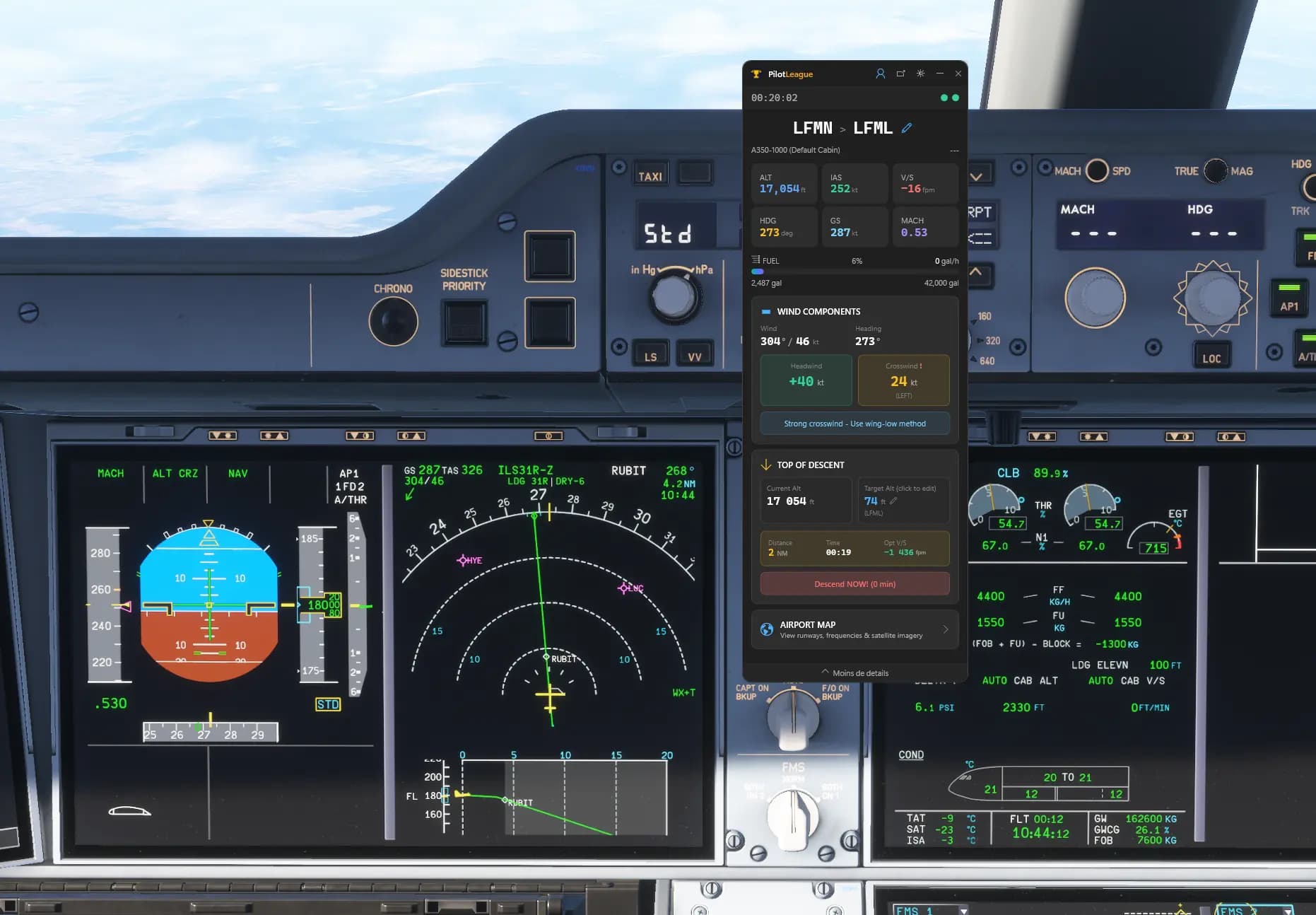
Calculate when to start your descent for a smooth approach.
PilotLeague TOD Calculator interface showing descent planning with altitude, distance and timing calculations
Enter as positive value (e.g., 1800 for -1800 fpm)
How to Calculate Top of Descent
The 3:1 rule is the simplest method for calculating your descent point: for every 1,000 feet you need to descend, start 3 nautical miles before your target.
Flying at FL350 (35,000 ft), targeting 3,000 ft pattern altitude:
Altitude to lose: 32,000 ft
Descent rate: 1,800 fpm
Ground speed: 450 kts
Result: Start descent ~133 NM out
Tips for MSFS 2024
In Microsoft Flight Simulator 2024, the most common mistake is starting descent too late. Aircraft with modern avionics (A320, B737) will show you a TOD marker on the ND, but it's always good to verify manually.
PilotLeague tracks your actual descent profile and compares it to the ideal path. You'll see exactly where you deviated and how it affected your score.
Before your flight, also plan your fuel for complete preparation.
A standard ILS approach uses a 3-degree glide slope, which translates to approximately 300 feet of altitude loss per nautical mile. Most airline SOPs are built around this 3° path, making it the universal reference for descent planning — whether you fly a PMDG 737, the FlyByWire A320, or a Cessna 172 in MSFS 2024.
Descent Rate vs Ground Speed
Your required descent rate depends directly on your ground speed. To maintain a 3° glide path, use this rule of thumb:
Required FPM = Ground Speed ÷ 2 × 10
At 250 kts → 1,250 FPM | At 300 kts → 1,500 FPM | At 450 kts → 2,250 FPM
Wind affects ground speed. A 30-knot headwind at cruise can shift your TOD point by 10 NM or more.
When to Start Your Descent — Rules of Thumb
The "Multiply by 3" Rule
The simplest mental math for TOD: take your altitude to lose in thousands of feet and multiply by 3. That gives the distance in nautical miles.
From FL350 to 2,000 ft → lose 33,000 ft → 33 × 3 = 99 NM. Begin descent about 99 NM from destination.
Add 1 NM per 10 knots of tailwind, subtract 1 NM per 10 knots of headwind for a quick wind correction.
VNAV vs Manual Descent
Aircraft with VNAV (Vertical Navigation) compute the TOD automatically based on flight plan constraints. In the PMDG 737 or FlyByWire A320, the FMC calculates a top-of-descent point shown as a green marker on the Navigation Display.
For aircraft without VNAV — like the default Cessna 172, TBM 930, or Baron 58 — you must calculate TOD manually. This is where PilotLeague's TOD calculator saves time during flight preparation.
Using TOD in MSFS 2024
Aircraft with Built-in VNAV
The PMDG 737 and FlyByWire A320 both feature functional VNAV in MSFS 2024. Program your STAR and approach in the FMC, set altitude constraints, and the aircraft computes the descent path. The TOD marker appears on the ND — descend when prompted. Always verify with manual calculation, as ATC step-downs and direct-to shortcuts can invalidate the computed path.
Aircraft Without VNAV
Most GA and default aircraft in MSFS 2024 lack VNAV capability. For the Cessna 172, TBM 930, or turboprops, use the "multiply by 3" rule or this calculator to plan your descent. Set a reminder on the GPS distance readout and begin descent at the calculated point. PilotLeague tracks your actual descent path and compares it to the optimal profile.
Frequently Asked Questions
How do I calculate Top of Descent?
Multiply your altitude to lose (in thousands of feet) by 3 to get the distance in nautical miles. For example, descending from FL350 to 2,000 ft means losing 33,000 ft → 33 × 3 = 99 NM. Start your descent approximately 99 NM from the airport.
What descent rate should I use?
For a standard 3° glide path, divide your ground speed by 2 then multiply by 10. At 250 knots: 250 ÷ 2 × 10 = 1,250 FPM. Most airline descents use between 1,000 and 2,000 FPM for passenger comfort.
What is the 3-degree glide path?
A 3° glide path is the standard descent angle used by most ILS approaches and commercial aircraft. It produces approximately 300 feet of altitude loss per nautical mile, providing a comfortable and fuel-efficient descent profile.
Does the PMDG 737 calculate TOD automatically in MSFS 2024?
Yes, the PMDG 737 for MSFS 2024 has a fully functional VNAV system that calculates Top of Descent automatically. Enter altitude constraints in the FMC and the green TOD marker appears on the Navigation Display. For aircraft without VNAV, use PilotLeague's free TOD calculator.
How does wind affect my Top of Descent?
Headwinds reduce ground speed, so you cover less distance during descent — start descending later (closer to the airport). Tailwinds increase ground speed, so start earlier (further away). Adjust by approximately 1 NM per 10 knots of wind.