Cessna 172 Fundamentals: The Complete MSFS 2024 Trainer Guide
By the PilotLeague Team — Aircraft Knowledge Module #3
The Cessna 172 Skyhawk is the most produced aircraft in aviation history — and for good reason. In MSFS 2024, it serves as the essential foundation for every virtual pilot learning general aviation fundamentals. Forgiving, stable, and honest, the C172 rewards proper technique and exposes sloppy habits without punishing you catastrophically.
Whether you are transitioning from airliners or starting your flight simulation journey from scratch, mastering the Cessna 172 will sharpen your <strong>energy management, crosswind technique, and circuit discipline</strong> in ways that benefit every aircraft you fly afterward. This guide covers everything from cold-start procedures to greaser landings at 65 KIAS.
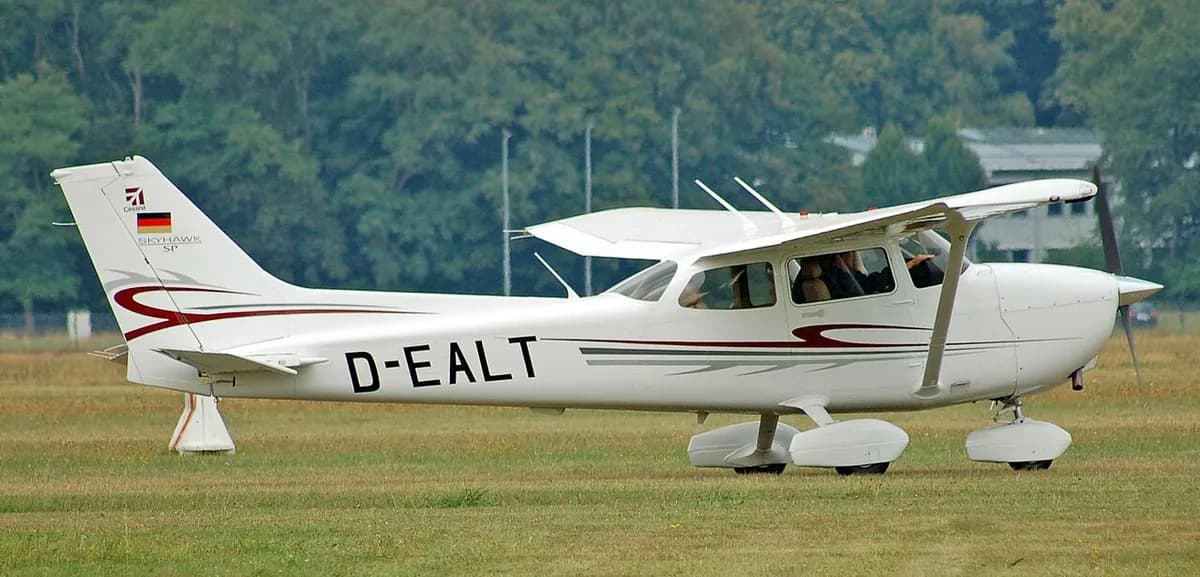
Cessna 172 Skyhawk — Photo: Frank Schwichtenberg, CC BY 3.0
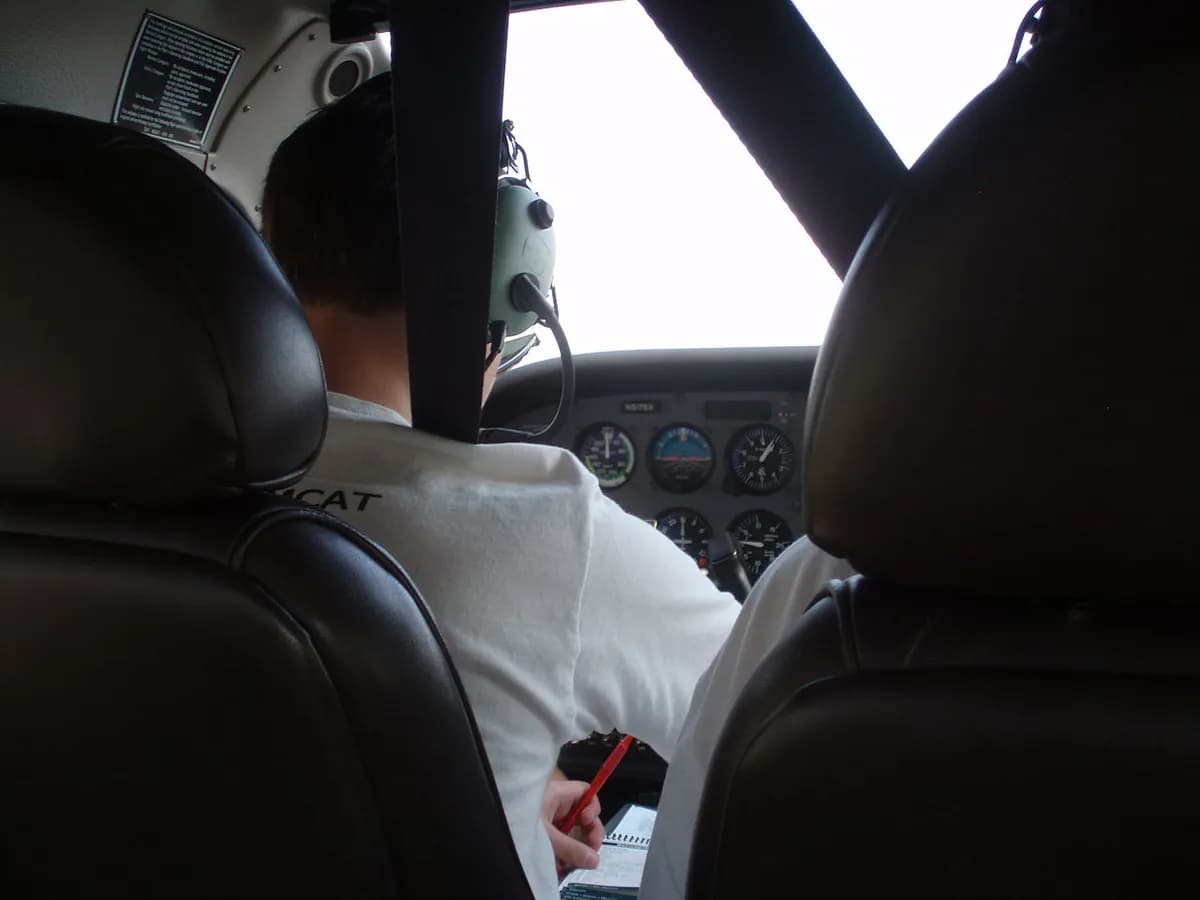
Cessna 172SP cockpit — Photo: Persist, CC BY-SA 3.0
Before your first flight, you must be fluent with the classic six-pack — the six primary flight instruments arranged in a standardized grid on the C172's analog panel. Unlike glass-cockpit airliners, the C172 trains your scan pattern from day one.
Airspeed Indicator (ASI)
Top-left position. Displays indicated airspeed in knots. Key arcs: white arc 40–85 KIAS (flap operating range), green arc 48–129 KIAS (normal operations), yellow arc 129–163 KIAS (caution, smooth air only), red line 163 KIAS (Vne — never exceed). During approach, target the white arc.
Attitude Indicator (AI)
Top-center position. The artificial horizon shows pitch and bank angle. In the C172, normal cruise attitude is approximately 2–3 degrees nose-up. During a standard rate turn, bank angle is typically 15–20 degrees. Vacuum-driven — check it is erect before takeoff.
Altimeter
Top-right position. Three-pointer altimeter reading in feet. Always set the Kollsman window to current QNH before flight. In the sim, press B to auto-set standard pressure or manually dial in the ATIS altimeter setting. Circuit altitude for C172 is typically 1,000 ft AGL.
Turn Coordinator
Bottom-left position. Shows rate of turn and coordination via the ball (inclinometer). Keep the ball centered using rudder — 'step on the ball' to correct. Standard rate turn (3°/sec) aligns the miniature aircraft's wing with the turn index marks.
Heading Indicator (DI)
Bottom-center position. Gyroscopic compass — must be aligned with the magnetic compass during straight-and-level flight every 15 minutes due to precession drift. Use it for precise heading holds; the magnetic compass is too sensitive for reading during turns.
Vertical Speed Indicator (VSI)
Bottom-right position. Shows rate of climb or descent in feet per minute. Note it is a lagging instrument — it takes 6–9 seconds to stabilize after a pitch change. Target descent rates: 500 fpm on final approach, never exceed 1,000 fpm near the ground.
The C172 also features a tachometer, fuel gauges, oil temperature, oil pressure, and ammeter on the lower panel. Engine instruments must be in the green arc before takeoff clearance. The avionics stack (typically a Garmin G1000 or GTN 750 in MSFS variants) sits center-right.
Engine & Carburetor Heat Management
The C172's Lycoming O-360-A4M (180 hp, naturally aspirated, four-cylinder horizontally opposed) is one of the most reliable piston engines in aviation — but it demands specific management techniques that differ fundamentally from turbine operations.
Cold Start Procedure
Set mixture to RICH. Prime 2–3 strokes (cold engine). Throttle 1/4 inch open. Master switch ON. Beacon ON. Fuel pump ON — check fuel pressure rises. Call 'Clear prop!' Magnetos to START. Once engine fires, release to BOTH. Set throttle to 1,000 RPM warm-up. Check oil pressure in the green within 30 seconds.
Carburetor Heat — The Critical Habit
The O-360's carburetor venturi can ice over at temperatures between -10°C and +20°C with humidity above 50% — conditions that exist even on mild days. Carb ice causes gradual RPM loss that pilots often misattribute to mixture or throttle issues. In MSFS 2024, carb ice modeling is active on the study-level C172 variants.
Apply CARB HEAT (hot) in these situations: power reductions below 2,000 RPM, descents and approach, any time RPM drops unexpectedly, flying in visible moisture or high humidity. When carb heat is applied, expect an initial RPM drop of 50–100 RPM as warm moist air enters — then a recovery if ice was present. Leave heat ON until RPM stabilizes.
Never apply carb heat at full power during takeoff — it reduces engine power and can introduce carb ice by slightly cooling the warm induction air. On go-around, carb heat goes OFF before applying full power.
Mixture Management
Below 3,000 ft MSL, operate with mixture FULL RICH for takeoff and climb. Above 3,000 ft, lean the mixture to peak RPM (or EGT if equipped). In MSFS, open the Engine page on the EFB or use the mixture lever — lean until RPM peaks, then slightly enrich. At cruise altitude (7,500–10,500 ft typical for C172), proper leaning recovers 10–15% fuel efficiency.
RPM Management
Normal cruise: 2,200–2,400 RPM (75% power = 2,450 RPM). Economy cruise: 2,100–2,200 RPM at lean mixture. Never exceed 2,700 RPM (red line). During run-up, check each magneto: select LEFT, note RPM drop (max 125 RPM, max differential 50 RPM between mags), select RIGHT, same check, back to BOTH. Carb heat check during run-up: apply, note RPM drop, remove, RPM returns.
Flight Characteristics & Handling
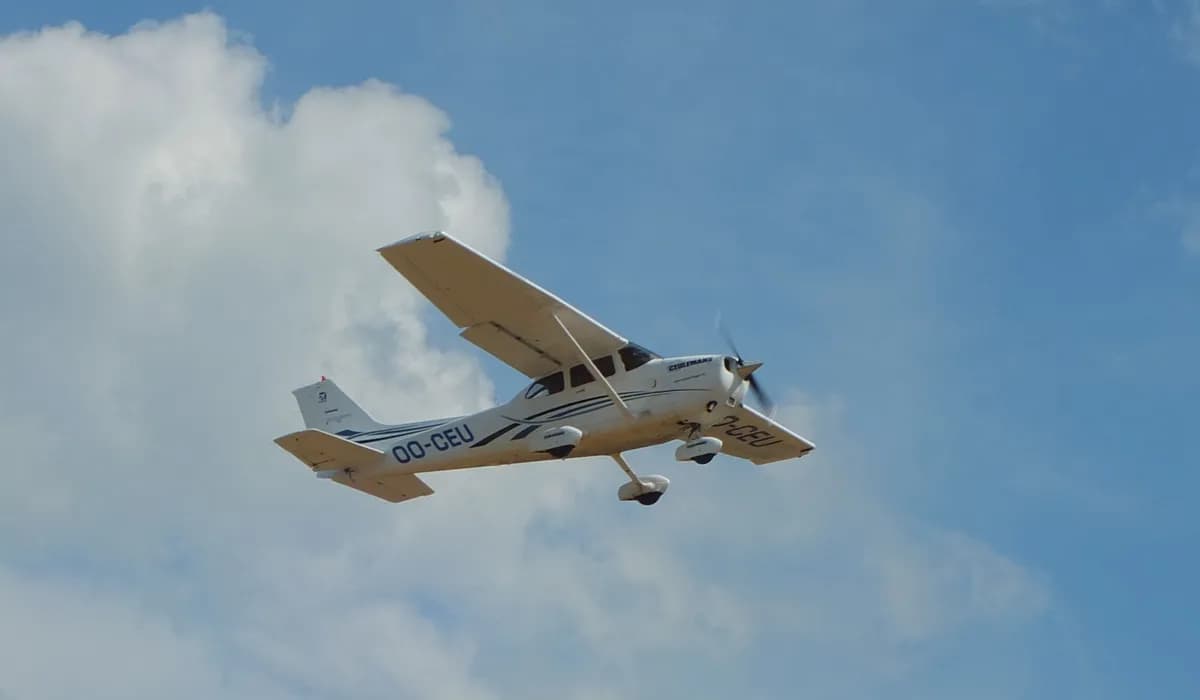
Cessna 172S — Photo: Ad Meskens, CC BY-SA 3.0
The C172's high-wing, tricycle-gear configuration gives it exceptional stability and docile handling — but also specific quirks that pilots must understand. Its self-correcting tendency in turbulence and generous stall margins make it an ideal learning platform for pattern work.
High-Wing Stability
The elevated wing position creates a pendulum effect — the heavy fuselage hangs below the lift source, naturally damping roll. This means the C172 resists steep bank angles and tends to return to wings-level without input. In MSFS, this translates to very smooth cruise flight in moderate turbulence. However, it also makes the aircraft more susceptible to crosswind weathervaning on the ground.
Stall Behavior
The C172's stall is one of the most benign in general aviation. Clean stall speed: 48 KIAS (Vs1). Full-flap stall: 40 KIAS (Vso). Stall warning activates 5–10 knots above stall. The break is straight ahead with minimal wing drop if coordination is maintained. Recovery: release back pressure, full power, carb heat off, retract flaps in stages. Practice power-off and power-on stalls regularly — PilotLeague safety scoring rewards clean stall recoveries.
Slow Flight & Pattern Work
Configure for slow flight: reduce power to 1,500 RPM, simultaneously raise nose to maintain altitude, apply carb heat. As speed bleeds to 55–60 KIAS, lower flaps incrementally (10°, then 20°). Apply 2,200–2,300 RPM to maintain altitude at full flap. Rudder authority is critical — the C172 requires significant right rudder to counteract left-turning tendencies (P-factor, torque, slipstream) at high power and low speed.
The Traffic Pattern at a Glance
Standard C172 pattern speeds: Crosswind 80 KIAS, Downwind 70–80 KIAS flaps 10°, Abeam threshold reduce to 1,500 RPM + flaps 20°, Base 65 KIAS + flaps 30°, Final 65 KIAS full flaps (40°). Pattern altitude 1,000 ft AGL. Never rush flap extension — deploy in stages with speed in the white arc. Each flap stage creates a pitch-down moment requiring nose-up trim.
The Perfect C172 Landing
Landing the C172 well is the benchmark skill for every PilotLeague GA pilot. The aircraft's light weight (max 2,550 lbs MTOW) and low approach speed make it unforgiving of poor energy management — but reward smooth, coordinated technique with consistently greaser touchdowns.
Stabilized Approach
Established on final: 65 KIAS, full flaps (40°), 500 fpm descent. Throttle controls descent rate; pitch controls airspeed. If you are high, reduce power — do not push the nose down and accept higher speed. If you are low, add power. The crosswind calculator is essential for C172 operations — its maximum demonstrated crosswind is 15 knots, and its light weight makes crosswind corrections mandatory.
The Roundout (Flare Initiation)
Begin the roundout at approximately 20 feet AGL — higher than in heavier aircraft. Smoothly reduce power toward idle while applying progressive back pressure. The nose rises gently. The C172 floats noticeably in ground effect due to its light wing loading — do not rush the flare. Hold the attitude and let the aircraft settle.
The Flare
Continue back pressure to arrest the descent rate. Target a nose-high, main-gear first touchdown with the nosewheel off the ground. The ideal touchdown attitude has the nose approximately 3–5 degrees above the horizon. Hold this attitude as speed decays — do not let the nose drop prematurely. Tricycle aircraft that touchdown nosewheel-first suffer prop strike risk and structural stress.
Touchdown & Rollout
Ideal touchdown: main wheels first, centerline, in the first third of the runway, at or near stall speed. After main gear contact, hold back pressure to keep the nosewheel off (aerodynamic braking) until below 50 KIAS, then gently lower the nose. Apply brakes symmetrically — the C172's drum brakes are effective but can lock up on a wet surface. Full flap retraction after clearing the runway.
Crosswind Landing Technique
Use the wing-low (sideslip) method: on final, into-wind aileron to prevent drift, opposite rudder to align fuselage with runway centerline. Maintain this crossed-control input throughout the flare. Touch down on the into-wind main wheel first, then lower the other main, then the nosewheel. After touchdown, aileron into the wind increases progressively as speed drops and aerodynamic control authority decreases.
Go-Around Decision
Initiate go-around if unstabilized below 500 ft AGL, if touchdown point is not assured, or if a bounce occurs. Go-around: full power (carb heat OFF first), pitch to Vx (59 KIAS), flaps to 20°, positive rate confirmed, flaps to 10°, flaps UP above 65 KIAS. PilotLeague safety scoring tracks go-around events — a timely go-around scores better than a salvaged bad landing.
Optimize Your Cessna 172 Score on PilotLeague
PilotLeague's scoring engine fully supports general aviation aircraft including the C172. GA scoring uses adapted thresholds calibrated to lighter aircraft — a 100 fpm touchdown is held to the same standard as a butter landing in an airliner.
GA Landing Score: For the C172, PilotLeague evaluates vertical speed at touchdown (target under 100 fpm), G-force (under 1.3g), touchdown zone accuracy, centerline deviation, bank angle, and crab angle. The C172's low approach speed makes sub-50 fpm touchdowns achievable with proper technique — aim for the top tier.
Fuel Efficiency Ranking: The C172's fuel burn of 8–10 GPH at cruise makes fuel management a meaningful scoring factor. Use the fuel planner before each flight to calculate optimal cruise altitude and mixture setting. PilotLeague's fuel score rewards pilots who arrive with planned reserves rather than draining tanks unnecessarily.
Safety Score Boosters: GA operations carry specific safety markers that PilotLeague monitors: no stall-speed violations below 1,000 ft AGL, no over-speed in the yellow arc, coordinated turns throughout (no slip/skid), and proper go-around execution. Flying clean circuits in the C172 consistently builds your safety score faster than any airliner operation.
Every C172 flight logged on PilotLeague builds your 50-flight rolling average across Landing (35%), Safety (30%), SOP (20%), and Fuel (15%) pillars. GA flights count equally alongside airliner flights — your Skyhawk circuits directly improve your global ranking.
The Cessna 172 is not a stepping stone to be left behind — it is a precision instrument that reveals every gap in your technique. Airline captains return to GA flying to sharpen their fundamentals precisely because there is nowhere to hide in a 172. No automation buffers a sloppy flare; no fly-by-wire masks an uncoordinated turn.
In MSFS 2024, the C172 rewards pilots who invest in understanding its systems: respect the carburetor, manage the mixture, fly coordinated, and grease it on at 65 KIAS. Do that consistently, and your PilotLeague score will reflect the discipline it takes — whether you are flying a Skyhawk or a 777.
Log your first C172 flight on PilotLeague today. The leaderboard has a place for every pilot who takes the fundamentals seriously.
Share
Practice Makes Perfect
Apply these techniques in your next flight and track your improvement with PilotLeague.