Night Landing: Mastering Darkness and Visual Illusions

By the PilotLeague Team - MSFS 2024 Advanced Guide

Landing at night is one of the most challenging aspects of flight simulation. The absence of visual ground references and loss of depth perception transform a routine approach into a surgical precision exercise.

To achieve a Butter Landing under the stars, you need to change your strategy. Your eyes lie to you in darkness — learn to rely on the right indicators.

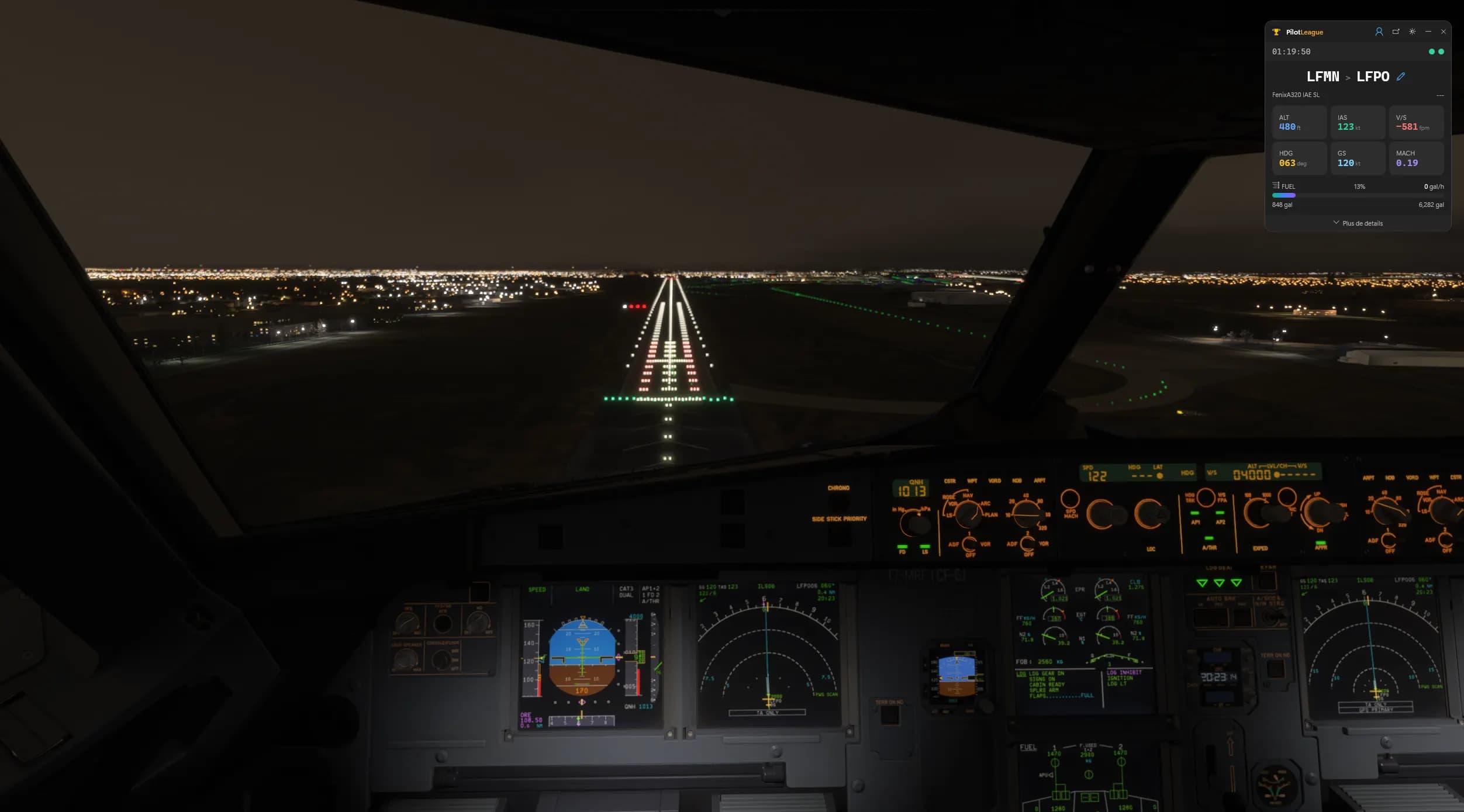
A320 cockpit view during night approach to Nice airport showing PAPI lights, runway lighting and PilotLeague overlay with flight parameters

To achieve a night Butter Landing, master the flare timing technique, and don't hesitate to execute a go-around if your approach isn't stabilized.

Analyze Your Night Landings with PilotLeague

Are your night landings harder than your day landings? PilotLeague lets you compare your performance:

PilotLeague automatically records and analyzes every night landing to identify your areas for improvement.

  • Day/Night Comparison: Identify if your average FPM increases significantly after sunset.
  • Lateral Precision: At night, pilots tend to deviate from the centerline. Check your "Lateral Offset" on your dashboard.
  • Safety Score: An unstabilized night approach should end with a go-around, rewarded by our safety algorithm.
Analyze My Night Flights →

Managing the "Black Hole" Illusion

The most dangerous illusion is the "Black Hole Approach". Without lights between you and the runway, you feel higher than you actually are, which pushes you to pitch down toward the ground.

Real Path (PAPI guided)Illusion: Feeling too highRunway lights

Diagram: The black hole illusion causes pilots to descend below the glidepath.

Trust Your Instruments (and the PAPI)

At night, your eyes lie to you. The golden rule is to fly by instruments until touchdown:

  • PAPI is vital: Keep your eyes on the two red and two white lights. If you see three reds, immediately add power.
  • Speed Management: Maintain a constant approach speed. Darkness makes last-minute corrections very risky.
  • Cockpit Lighting: Reduce your screen brightness (dimming) to preserve your night vision and better see runway lights.

Night Flare Timing

Perceiving your height at 10 feet above ground is complex in the dark. Use the Runway Edge Lights that start to "scroll" faster to identify the flare moment. Don't look for visual contact with the asphalt — rely on the perspective of lights converging toward the horizon.

Pro Tip: Keep your gaze toward the far end of the runway, not directly below the aircraft. The side runway lights will give you the sensation of scrolling speed.
Analyze Your Night Landings with PilotLeague

Are your night landings harder than your day landings? PilotLeague lets you compare your performance:

  • Day/Night Comparison: Identify if your average FPM increases significantly after sunset.
  • Lateral Precision: At night, pilots tend to deviate from the centerline. Check your "Lateral Offset" on your dashboard.
  • Safety Score: An unstabilized night approach should end with a go-around, rewarded by our safety algorithm.
Analyze My Night Flights →

Continue your progression

Touchdown Zone Precision GuideNight Crosswind TechniquesFlare Timing Mastery

Night is No Longer an Obstacle

Don't let darkness hide your mistakes anymore. With the right reflexes and PilotLeague tracking, turn night flights into a demonstration of your professionalism.

Practice Makes Perfect

Apply these techniques in your next flight and track your improvement with PilotLeague.

Download PilotLeague Free
Landing MasteryBack to Flight Academy